Showing posts with label KONKAN. Show all posts
Showing posts with label KONKAN. Show all posts
Friday, 9 October 2015


Thursday, 8 October 2015
Exploring Sarve, Part 5 - Bibi's Legacy
My second day at Sarve was spent mostly idling around the village and talking to some of the villagers about Sarve.
The original plan was to watch the sunrise from over a small hill at the northen end. That was junked as soon as I realized that I had overslept. My Pune mates had already departed due to some work back home and I was to myself for the day. After a quick breakfast at Mt. Kifayat’s house, Nasir escorted me back to his own house where Mr. Sabir was already waiting for me.
The sun was up to and the sea-breeze was yet to pick up. We decided to start the warm day with a walk along the shore northwards, and then return via the main street. One of the prominent landmarks of the shore is the skeleton of a whale that had beached here a few years ago. The sheer size of the skeleton is amazing. This one is probably bigger than the one kept in the Ratnagiri aquarium.

Further north, we came upon a natural pool that was completely taken over by a herd of buffaloes. Our presence was duly resented and we started our way back.

I departed Sarve after another hearty lunch with a combination of bike ride, hitchhike and bus ride.

Bibi:
One of the persons we met on our way back casually spoke about Bibi Mukadam as one of the famous people from Sarve. The name never registered in my head, until Mr. Sabir brought up the topic again during lunch at this place. According to him, Bibi Mukadam lived in the village in a political exile from her homeland of South Africa where she was a prominent part of the anti-apartheid movement under Nelson Mandela. She was also a friend of the late Mrs. Indira Gandhi, who had visited her at Sarve during her Prime Ministerial days without any security detail. I made a note of this story with a point of exploring in detail once I got home.
-x-x-x-
Born as Ms. Ayesha Bibi Dawood in Worcester, South Africa, she later married a seaman Mr. Yusuf Mukadam from Sarve, India. The details of her life are well documented by the South African government ( Link 1 ; Link 2 ). This is a very exciting discovery, especially since there is hardly any mention or knowledge that such a person existed and made a remote corner of our country her home for most of her life.

Mr. Sabir’s words ring out clearly here: “She lived among us as one of us. Yet when one was around her one could feel greatness exude from herself. The way she carried herself clearly marked her as a prominent person. Yet, we did not know who she was. Nor did she ever tell herself.”
Bibi returned to the country of her birth in the 1990s. After her death, a steady trickle of journalists from South Africa happened to make their way to Sarve. That’s when the real magnitude of her greatness dawned on the people. Yet today her story is not well known even in Sarve.
Let’s hope for the best – for Bibi’s legacy and for Sarve…
© Kapil Pilankar
The original plan was to watch the sunrise from over a small hill at the northen end. That was junked as soon as I realized that I had overslept. My Pune mates had already departed due to some work back home and I was to myself for the day. After a quick breakfast at Mt. Kifayat’s house, Nasir escorted me back to his own house where Mr. Sabir was already waiting for me.
The sun was up to and the sea-breeze was yet to pick up. We decided to start the warm day with a walk along the shore northwards, and then return via the main street. One of the prominent landmarks of the shore is the skeleton of a whale that had beached here a few years ago. The sheer size of the skeleton is amazing. This one is probably bigger than the one kept in the Ratnagiri aquarium.

A whale vertebra
Further north, we came upon a natural pool that was completely taken over by a herd of buffaloes. Our presence was duly resented and we started our way back.

Moooo ...
I departed Sarve after another hearty lunch with a combination of bike ride, hitchhike and bus ride.

The way back home
One of the persons we met on our way back casually spoke about Bibi Mukadam as one of the famous people from Sarve. The name never registered in my head, until Mr. Sabir brought up the topic again during lunch at this place. According to him, Bibi Mukadam lived in the village in a political exile from her homeland of South Africa where she was a prominent part of the anti-apartheid movement under Nelson Mandela. She was also a friend of the late Mrs. Indira Gandhi, who had visited her at Sarve during her Prime Ministerial days without any security detail. I made a note of this story with a point of exploring in detail once I got home.
-x-x-x-
Born as Ms. Ayesha Bibi Dawood in Worcester, South Africa, she later married a seaman Mr. Yusuf Mukadam from Sarve, India. The details of her life are well documented by the South African government ( Link 1 ; Link 2 ). This is a very exciting discovery, especially since there is hardly any mention or knowledge that such a person existed and made a remote corner of our country her home for most of her life.
Recognition by the Government of South Africa
Mr. Sabir’s words ring out clearly here: “She lived among us as one of us. Yet when one was around her one could feel greatness exude from herself. The way she carried herself clearly marked her as a prominent person. Yet, we did not know who she was. Nor did she ever tell herself.”
Bibi returned to the country of her birth in the 1990s. After her death, a steady trickle of journalists from South Africa happened to make their way to Sarve. That’s when the real magnitude of her greatness dawned on the people. Yet today her story is not well known even in Sarve.
Let’s hope for the best – for Bibi’s legacy and for Sarve…
© Kapil Pilankar
Thursday, 1 October 2015
Exploring Sarve, Part 4 - Of Fishes and Govinda
Our evening at Sarve was flowing along as we chatted about our lives, our work, our worlds and our universe ... a full 42 conversation. the lazy flow of the evening was interrupted when Mr. Sabir asked us to get ready for the activity of the night - fishing!
Something Fishy ...
We accompanied him as he went to check on his net that he had cast neat the shallow pools. Wading through knee deep water, we made our way to the net. There was a fish, locally called ‘hausa’, which was caught in the net. It has a sharp dorsal fin equipped with a sting that hurts like that of a scorpion’s. Mr. Sabir carefully untangled it from the net and kept it on the dry rocks nearby, while we continued onward to inspect the rest of the net.

Here we found a few crabs and one water-snake which were also caught in the net. Mr. Sabir gave us a lesson crab-catching. The only way to safely catch a crab is by gently pushing the head so that it just stops in its tracks and then carefully bundle the claws in. In such a position they are mostly harmless.

We returned to the house with our catch - ‘hausa’. That fish would fetch about Rs. 150-200 if sold to the Kunbi casts people. Kolis and Muslims will not pay even Rs. 10 for it, we were told.

Gooovindaaa re Gooopala ...
We had a light vegetarian dinner after which we made our way to Mr. Kifayat’s house, where we were to spend the night. His house was at the other end of the village and the short walk almost seemed like a guided tour of the village itself. Another relaxed session of chatting ensued - this time our religion and beliefs were added to the general mix. This session lasted till almost midnight, when we again left the house to attend the Janmasthami celebrations at the village temple.
We made our way to the temple and were greeted by the Sarpanch and other elders. The ex-Sarpanch sat with us and gave a brief account of the village conditions and customs. A quick cup of black tea was served as the puja began with the priest narrating a dramatic account of the birth of Lord Krishna. The fervor of his pitch steadily rose as the time of Lord’s birth drew near. The main aarti started sharp at midnight. This was followed by a short procession of village kids dancing along to ‘goooooooovindaaa re goooopaalaaa …’.

We joined the fun and were quickly drenched as the villagers threw bucket after bucket of water on the kids and by extension us too.

After a while we excused ourselves and returned back to Mr. Kifayat's house for some much needed rest after a long but fun day.
© Kapil Pilankar
Something Fishy ...
We accompanied him as he went to check on his net that he had cast neat the shallow pools. Wading through knee deep water, we made our way to the net. There was a fish, locally called ‘hausa’, which was caught in the net. It has a sharp dorsal fin equipped with a sting that hurts like that of a scorpion’s. Mr. Sabir carefully untangled it from the net and kept it on the dry rocks nearby, while we continued onward to inspect the rest of the net.

The Hausa
Here we found a few crabs and one water-snake which were also caught in the net. Mr. Sabir gave us a lesson crab-catching. The only way to safely catch a crab is by gently pushing the head so that it just stops in its tracks and then carefully bundle the claws in. In such a position they are mostly harmless.

Crab catching
We returned to the house with our catch - ‘hausa’. That fish would fetch about Rs. 150-200 if sold to the Kunbi casts people. Kolis and Muslims will not pay even Rs. 10 for it, we were told.

Older catch - hausa and boi - now frozen
Gooovindaaa re Gooopala ...
We had a light vegetarian dinner after which we made our way to Mr. Kifayat’s house, where we were to spend the night. His house was at the other end of the village and the short walk almost seemed like a guided tour of the village itself. Another relaxed session of chatting ensued - this time our religion and beliefs were added to the general mix. This session lasted till almost midnight, when we again left the house to attend the Janmasthami celebrations at the village temple.
We made our way to the temple and were greeted by the Sarpanch and other elders. The ex-Sarpanch sat with us and gave a brief account of the village conditions and customs. A quick cup of black tea was served as the puja began with the priest narrating a dramatic account of the birth of Lord Krishna. The fervor of his pitch steadily rose as the time of Lord’s birth drew near. The main aarti started sharp at midnight. This was followed by a short procession of village kids dancing along to ‘goooooooovindaaa re goooopaalaaa …’.

We joined the fun and were quickly drenched as the villagers threw bucket after bucket of water on the kids and by extension us too.

After a while we excused ourselves and returned back to Mr. Kifayat's house for some much needed rest after a long but fun day.
© Kapil Pilankar
Saturday, 26 September 2015
Exploring Sarve, Part 3 - A Hidden Cascade
We are at Mr. Sabir’s place after the seeing the viewpoints. He has to attend an urgent meeting in the village and takes our leave. Shortly, Nasir and Jamil, sons of Mr. Sabir and Mr. Kifayat respectively, make an appearance. Nasir, as described earlier, studies in the local ITI. They are to guide us to a waterfall located about 30 minutes inland. Mr. Sabir’s youngest daughter, Mantshaa, would also accompany us.
The waterfall is to the south-east of the village. We cross the small stream just beyond the last of the houses that is fed by the waterfall and ascend along the left (southern) bank. The path makes its way gradually in to the thick forest. We pass a small waterfall along the way followed by a small meadow of pink wildflowers. The forest is denser from here on.

Out path is blocked twice by huge spider webs under which we duck to pass through.

The path has overgrown bushes throughout. Nasir has carried a sickle for precisely this task and clears them. The path, it seems, was not used frequently.

The roar of the waterfall announced its proximity before we had an opportunity to see it. Even then, the waterfall had us in awe once we saw it. Water fell heavily from a stream for about 100 feet into a pool of clear water. The pool was not too deep and was safe for a quick dip. Behind the waterfall, the waters had carved out a very cozy cavern.

We lazed around the waterfall for a good part of the hour before our guides decided it was time we moved on. The waterfall belonged to the forest folks after dark - peacocks and other birds, deer, boar and leopards.

After descending about halfway through the trail, our guides asked us to halt for some time and promptly disappeared along a side trail. Waiting for about 15 minutes, and hearing their not so distant voices, got the better of my curiosity and I decided to follow. To my surprise, I saw Jamil halfway up a coconut tree, trying to desperately scythe free some fresh coconuts for the lot of us. Nasir, wearing jeans, belted instructions from below. It was quite a scene.

The duo returned with their loot of one coconut for each of us. i tried my luck with scything open one, but it ultimately had to be done by Nasir.


As we returned to the main road, the sun had already painted the sky crimson-orange as it prepared to set. We sat down on a grassy knoll to watch the view as peacocks kee-oik-ed in the distance.


By the time we returned to Mr. Sabir’s house, the last of the evening light was cast over the horizon. We freshened up and settled down for a lazy evening chat.

© Kapil Pilankar

Pink bloom
Out path is blocked twice by huge spider webs under which we duck to pass through.

The spider guardian
The path has overgrown bushes throughout. Nasir has carried a sickle for precisely this task and clears them. The path, it seems, was not used frequently.

Clearing up the path
The roar of the waterfall announced its proximity before we had an opportunity to see it. Even then, the waterfall had us in awe once we saw it. Water fell heavily from a stream for about 100 feet into a pool of clear water. The pool was not too deep and was safe for a quick dip. Behind the waterfall, the waters had carved out a very cozy cavern.

The waterfall and the small cavern
We lazed around the waterfall for a good part of the hour before our guides decided it was time we moved on. The waterfall belonged to the forest folks after dark - peacocks and other birds, deer, boar and leopards.
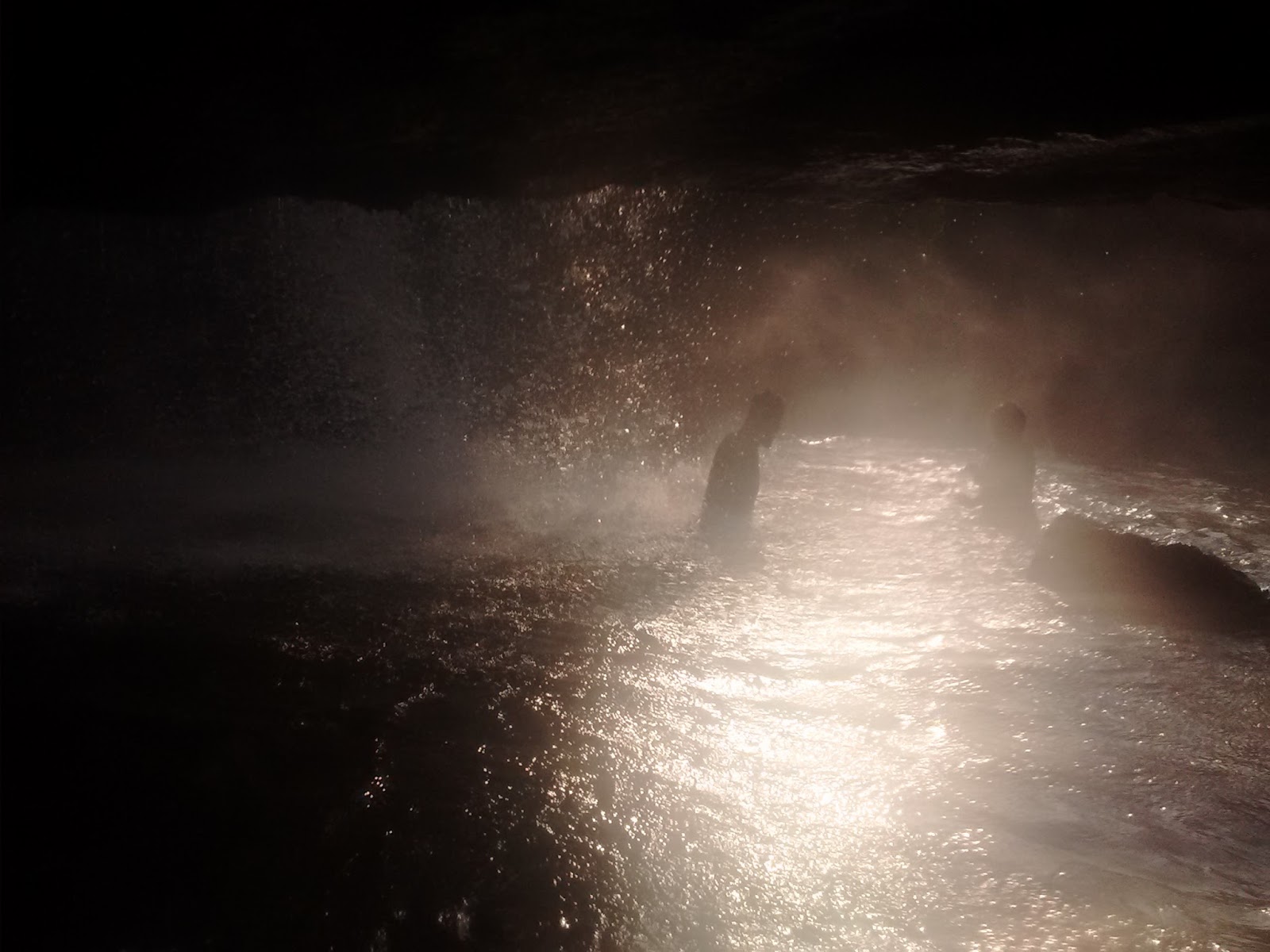
A view from the cavern
After descending about halfway through the trail, our guides asked us to halt for some time and promptly disappeared along a side trail. Waiting for about 15 minutes, and hearing their not so distant voices, got the better of my curiosity and I decided to follow. To my surprise, I saw Jamil halfway up a coconut tree, trying to desperately scythe free some fresh coconuts for the lot of us. Nasir, wearing jeans, belted instructions from below. It was quite a scene.

Caught in the act ...
The duo returned with their loot of one coconut for each of us. i tried my luck with scything open one, but it ultimately had to be done by Nasir.

Nasir scything coconuts

Jamil in action
As we returned to the main road, the sun had already painted the sky crimson-orange as it prepared to set. We sat down on a grassy knoll to watch the view as peacocks kee-oik-ed in the distance.

Evening colours

The setting sun
By the time we returned to Mr. Sabir’s house, the last of the evening light was cast over the horizon. We freshened up and settled down for a lazy evening chat.

Twilight by the sea ...
© Kapil Pilankar
Sunday, 20 September 2015
Exploring Sarve, Part 2 - A Lighthouse, Two Forts and A Healer
The Lighthouse
Post lunch, we drift into small talk to keep off the slumber. A little while later, we are on our way to the village of Nanivali, further north on the road to Dighi. Mr. Sabir tells us there are amazing view-points along the road.
As soon as we leave Sarve, the road winds up a steep incline. The village of Nanivali is located a higher elevation, yet lies along the shore. A kilometer before the village is the first viewpoint which offers a view of the Dighi lighthouse.

This lighthouse assumes significance due to the high activity at the Dighi Port and the rocky shores around it. There’s no direct road to the light house and one has to trek a distance of about 200mts from the last road head. From the village of Sarve, the lighthouse is an enjoyable trek of about two hours over a part rocky, part sandy, part uphill route right next to the shoreline.
The Two Forts
The second view-point is just outside the Nanivali village. Standing here, one can view the majestic Janjira fort and the relatively isolated and unknown Padmadurg in a single field of view - though not on camera. The entire Murud village is seen from this spot.

The fort of Janjira, as described earlier, was the heart of the Siddi kingdom. The mighty fortress has stayed undefeated till Indian independence, after which it was integrated into the Indian state. With its integration, the inhabitants of the island fort gradually returned to the mainland, leaving the fort into the hands of nature and the beleaguered ASI. Sixty years of negligence has taken a great toll on the fort, yet it stands as majestic as ever.

Padmadurg, on the other hand was built by the Marathas with the sole purpose of defeating Janjira. Legend goes that the fort was completed in a night, since by day the Siddi troops would attack and destroy whatever progress was made. Marathas, under the leadership of Sambhaji Maharaj almost accounted for Janjira when an attack from the north by Aurangzeb forced them to divert their attention there.
The Healer
On our way back, we stop by an isolated hut with an aim to get a better photo of the lighthouse.

The hut belongs to a local healer from Nanivali. This man is a thinly built sexagenarian with a failing vision, yet as sprightly as a lamb. He relies on the traditional arts of healing handed over from generations and in return expects just a token of coconut as a payment.


Throughout our conversation he emphasizes the importance of time in the medical practice, a fact that sadly escapes many in the modern medical setup as is so frequently observed.
We take their leave and return to Mr. Sabir's place.
© Kapil Pilankar
Post lunch, we drift into small talk to keep off the slumber. A little while later, we are on our way to the village of Nanivali, further north on the road to Dighi. Mr. Sabir tells us there are amazing view-points along the road.
As soon as we leave Sarve, the road winds up a steep incline. The village of Nanivali is located a higher elevation, yet lies along the shore. A kilometer before the village is the first viewpoint which offers a view of the Dighi lighthouse.

The lighthouse
This lighthouse assumes significance due to the high activity at the Dighi Port and the rocky shores around it. There’s no direct road to the light house and one has to trek a distance of about 200mts from the last road head. From the village of Sarve, the lighthouse is an enjoyable trek of about two hours over a part rocky, part sandy, part uphill route right next to the shoreline.
The Two Forts
The second view-point is just outside the Nanivali village. Standing here, one can view the majestic Janjira fort and the relatively isolated and unknown Padmadurg in a single field of view - though not on camera. The entire Murud village is seen from this spot.

Janjira, with Murud in the background
The fort of Janjira, as described earlier, was the heart of the Siddi kingdom. The mighty fortress has stayed undefeated till Indian independence, after which it was integrated into the Indian state. With its integration, the inhabitants of the island fort gradually returned to the mainland, leaving the fort into the hands of nature and the beleaguered ASI. Sixty years of negligence has taken a great toll on the fort, yet it stands as majestic as ever.

Padmadurg - a faint speck in the distance
Padmadurg, on the other hand was built by the Marathas with the sole purpose of defeating Janjira. Legend goes that the fort was completed in a night, since by day the Siddi troops would attack and destroy whatever progress was made. Marathas, under the leadership of Sambhaji Maharaj almost accounted for Janjira when an attack from the north by Aurangzeb forced them to divert their attention there.
The Healer
On our way back, we stop by an isolated hut with an aim to get a better photo of the lighthouse.

The hut with a view ...
The hut belongs to a local healer from Nanivali. This man is a thinly built sexagenarian with a failing vision, yet as sprightly as a lamb. He relies on the traditional arts of healing handed over from generations and in return expects just a token of coconut as a payment.

The entrance to the hut

The cowshed
Throughout our conversation he emphasizes the importance of time in the medical practice, a fact that sadly escapes many in the modern medical setup as is so frequently observed.
We take their leave and return to Mr. Sabir's place.
© Kapil Pilankar
Wednesday, 16 September 2015
Exploring Sarve, Part 1 - Introductions
Sarve, Habsan
Murud, along the coast of Raigad district in Maharashtra is a well known tourist spot famous for the impregnable and undefeated sea-fort of Janjira. The Siddi Dynasty exerted uninterrupted control over the island fort and the surrounding region - called Habsan - from the late 15th century, right up to its ascension into the Indian Republic in 1948, resisting attacks by the Marathas, British, Portuguese and the Dutch.
A little south of Murud, across the Dighi creek lies the sleepy coastal village of Sarve, also a part of the erstwhile Habsan state.

Sarve - as it stands today - is an up and coming rural-tourism destination. The village seeks to promote a unique brand of sustainable rural tourism by relying on community support and making the best use of its available natural resources. In this, they are actively supported by the Swades Foundation and Grassroutes.
The village also has a unique identity with its association with South African anti-apartheid crusader Ayesha (Bibi) Dawood. Sadly, this important thread of history is slowly being forgotten. So much so, that I only learnt about it after being given a passing reference just ahead of my departure from the village.
The village of Sarve has three major communities - Muslims, Kolis and Kunbis (in no particular order).
Approaching Sarve
Sarve can be approached by two routes:
We - me and my mates from Pune - took the first route. After crossing the Velas Agaar village - not to be confused with the one in Ratnagiri famous for the turtle hatchlings - the road aligns itself right next to the coast. The rocky shore near Velas Agar - with its peculiar temple - slowly gives way to a fabulous beach at Aadgaon.


The road climbs here, away from the shore, and then rejoins as the village of Sarve with its rocky shore falls into view.
Our Hosts
Near the first set of houses on the shore-side we are greeted by our host for the weekend, Mr. Sabir Mukadam alongwith Mr. Kifayat Chougule, our co-host. He spearheads the rural-tourism initiative of the local community and is usually the first point of contact. He is a sharp man, in mid 40s, driven by a purpose.
He had spent most of his prime in Mumbai, working hard to make his ends meet and save for the family back home. After saving enough to construct his own house, he returned to Sarve, mostly empty handed, but with a vision for the future. We met up with his family - wife and three daughters. The son, now studying in an ITI, was out and would return later in the day.
His modest house is bang on the shoreline at about 20 steps from the water, but at a safe elevation. Over lunch, he narrates a story of one of the many severe coastal storms his house has endured. We listen, enchanted by the narrative.

The lunch itself is a modest fare, in sync with the general mood of the place. Yet there’s enough opulence in hospitality that makes everything a lavish affair. The food stays vegetarian, owing to the month of Shravan. The non-vegetarian delicacies will have to be sampled next time.
Oh yes, the non-vegetarian diet primarily includes fish - caught by hands as they drift into the shallow pools formed by the rocky shoreline. We are told we would be trying that in the evening. Excited smiles abound!
Contact Info:
For bookings, Sabir Mukadam can be reached on 7588650329. Alternately, Rudes Gaikar of the Swades Foundation be reached on 9209715520.
© Kapil Pilankar
Murud, along the coast of Raigad district in Maharashtra is a well known tourist spot famous for the impregnable and undefeated sea-fort of Janjira. The Siddi Dynasty exerted uninterrupted control over the island fort and the surrounding region - called Habsan - from the late 15th century, right up to its ascension into the Indian Republic in 1948, resisting attacks by the Marathas, British, Portuguese and the Dutch.
A little south of Murud, across the Dighi creek lies the sleepy coastal village of Sarve, also a part of the erstwhile Habsan state.

Sarve - on the map
Sarve - as it stands today - is an up and coming rural-tourism destination. The village seeks to promote a unique brand of sustainable rural tourism by relying on community support and making the best use of its available natural resources. In this, they are actively supported by the Swades Foundation and Grassroutes.
The village also has a unique identity with its association with South African anti-apartheid crusader Ayesha (Bibi) Dawood. Sadly, this important thread of history is slowly being forgotten. So much so, that I only learnt about it after being given a passing reference just ahead of my departure from the village.
The village of Sarve has three major communities - Muslims, Kolis and Kunbis (in no particular order).
Approaching Sarve
Sarve can be approached by two routes:
- Mangaon - Mhasala - Vadavli Phata - Aadgaon - Sarve
- Alibag/Roha - Murud - Agardanda - Ferry- Dighi - Sarve
We - me and my mates from Pune - took the first route. After crossing the Velas Agaar village - not to be confused with the one in Ratnagiri famous for the turtle hatchlings - the road aligns itself right next to the coast. The rocky shore near Velas Agar - with its peculiar temple - slowly gives way to a fabulous beach at Aadgaon.

The peculiar temple at Velas Agaar - on a rock! I regret not taking a closer pic.

The Aadgaon Beach
The road climbs here, away from the shore, and then rejoins as the village of Sarve with its rocky shore falls into view.
Our Hosts
Near the first set of houses on the shore-side we are greeted by our host for the weekend, Mr. Sabir Mukadam alongwith Mr. Kifayat Chougule, our co-host. He spearheads the rural-tourism initiative of the local community and is usually the first point of contact. He is a sharp man, in mid 40s, driven by a purpose.
He had spent most of his prime in Mumbai, working hard to make his ends meet and save for the family back home. After saving enough to construct his own house, he returned to Sarve, mostly empty handed, but with a vision for the future. We met up with his family - wife and three daughters. The son, now studying in an ITI, was out and would return later in the day.

Mr. Sabir's House and the rocky shoreline
The lunch itself is a modest fare, in sync with the general mood of the place. Yet there’s enough opulence in hospitality that makes everything a lavish affair. The food stays vegetarian, owing to the month of Shravan. The non-vegetarian delicacies will have to be sampled next time.
Oh yes, the non-vegetarian diet primarily includes fish - caught by hands as they drift into the shallow pools formed by the rocky shoreline. We are told we would be trying that in the evening. Excited smiles abound!
Contact Info:
For bookings, Sabir Mukadam can be reached on 7588650329. Alternately, Rudes Gaikar of the Swades Foundation be reached on 9209715520.
© Kapil Pilankar
Friday, 22 May 2015
The Vengurla Backpack Trip: Day 2, 3 and Closing Notes
Day2: Sunday, 26th April, 2015
Continued from Part 2
1730 hrs:
Our train is announced. It is on time. We've successfully spent an hour doing nothing. Just freshened up a little. There's not much available at the Sawantwadi station, so we pack a few snacks and water for the return trip. Neither of us are very hungry anyway.
1733 hrs:
The train arrives and leaves almost immediately after we board.
1915 hrs:
Vada pav at Vaibhavwadi is our final snack for the day. We pack off to sleep. Luckily we have upper berth tickets so we can do so without disturbing anyone else.
-x-x-x-
Day3: Monday, 27th April, 2015
0300 hrs:
Tejal frantically wakes me up. The train is already at Panvel. Bang on time and least expected. We scramble out of the train with our minimal luggage. The train leaves after a few minutes. And with that our trip ends. A good trip, and totally worth doing again.
-x-x-x-
Some Important Contacts:
1: Hotel Sagar Darshan, Bhogawe
Homestay at Bhogawe, ideally set overlooking the Devbag Sangam. And isolated too.
Room rates start at Rs 600. Group accommodation available.
Contact: 7588448424
2: Simran Tours & Travels, Sawantwadi
Two wheelers on hire. Rates start at Rs 200 per day.
C/O at Mujib Video Game Parlour
Contact: 02363-274587, 9404448030, 9423051556
3: Pappu Tours & Travels, Sawantwadi
Two wheelers on hire. Rates start at Rs 200 per day.
C/O at Kadar Watch Dealers
Contact: 02363-275392, 9823147407
-x-x-x-
Some Insights:
1: Train travel through Konkan region can be very unpredictable. If you are planning to backpack through the region, always have a contingency plan at the back of your mind if you don't want your trip to be thrown off track entirely
2: Road travel is no less unpredictable though. Narrow winding roads are aplenty here. Add to that the inclines and declines and you have a very tricky combination. The road quality is good though.
3: Best time to be in Vengurla is sometime after the monsoon to about new year. The beaches are at their best and you can expect a decently cold night. Noons will be hot though.
4: There are plenty of mango orchards by the roadside. But they are guarded very well. Beware in case you plan to 'borrow' some.
5: Apart from mangoes all local fruit is easily available at local markets. The Vengurla cashew is famous too.
6: Quite a few accommodation options are available. The MTDC Bed & Breakfast list for Sindhudurg is a good directory of places and rates.
7: The people of this region are generally good-natured. Though the ill-effects of the easy tourism money is beginning to show. Be aware of the rates and beware of cons.
Yewa ... Konkan aaploch asa ...
The Vengurla Backpack Trip had us travelling through places like Sawantwadi, Vengurla, Kondura, Mhapan, Bhogawe and Nivati. These places are as yet unexplored and hence offer a very rare kind of solace. In all the places that we touched, we were the only non locals and that too at the peak of the vacation season.
It has been a great trip. There's a lot of ground to be covered as yet: Amboli, Mochemad, Airavali, Terekhol beckons ... Fingers crossed ...
© Kapil Pilankar
Sunday, 10 May 2015
The Vengurla Backpack Trip: Day 2, Part 2
Day2: Sunday, 26th April, 2015
Continued from Part 1
1215 hrs:
We arrive at Nivati Fort bus stop, park the bike and head to the beach. The bus stop is about 80-100 feet above the sea level so one has to walk down a slope to the beach. The beach is a dual beach, the northern and southern sections separated by the Nivati Golden rock - called such because the composing rocks apparently tend to glow during sunrise. The southern beach was the one seen by Tejal from the boat. This section can only be approached after wading through thigh deep water. So, we head to the northern section.
1220 hrs:
The beach is small and cute and with calm welcoming waters. However there is some algae in the water so we don't go in. There are some rocks with shade at the far end. We have a seat here with a very good view. We finally decide to have the little hearts. From now on we decide to rate beaches by little hearts. This one gets 3.5 out of a possible 5.

The Nivati Goden Rock in the distance
1225 hrs:
We head to the Golden Rock. There's a pathway that we can see from our seat. We think that it might lead us to the southern side. We ascend the rock. Its a steep fall on the other side, but the view is simply magnificent. Clean turquoise blue waters, a white strip of sand, idling waves and a smallish lagoon. We rate the beach 4/5 hearts.

A magnificent view and a poor picture
1235 hrs:
We descend from the rock to the northern face and head to the bike. A mad-ish dog is tethered next to the parking area. It thrashes around to free itself. Nearly succeeds. We inform some local people.
1240 hrs:
The locals seem to take no notice of the dog. We flee from there. Its back to Mhapan for lunch.
1315 hrs:
We are at Bhogate's Mess. This time its chicken thali with surmai fry for both of us. We make our love of solkadi known to the owner. He might run out of it soon if we continue our expression of this love. The food is, again, very good. We have a bill of Rs 500 - surmai is expensive after all.
1400 hrs:
We leave from Mhapan. We have to reach Sawantwadi by 1630 hrs. We decide to use the Parule-Kudal-Sawantwadi route rather than the Vengurla road. This is a better road - better quality, less inclines and less curves - and hence faster.
1450 hrs:
We reach Pinguli, bypass Kudal and head to Sawantwadi through the Goa highway. We take a watermelon break once on the highway. It seems the fuel would barely last us till Sawantwadi. We decide to fuel up a little ahead.

<insert witty caption :P>
1530 hrs:
We are back to hotel Viva Konkan from where the action started yesterday. We have refuelled at a new petrol pump opposite to the hotel. It took some amount of convincing to get fuel worth Rs 30. The attendant was adamant on Rs 50 minimum value. We have some time to freshen up, which we do.
We call up the bike owner to ask if he can collect the bike at Sawantwadi station. He readily agrees. Well, we just saved at least half an hour worth of the bike ride and a round about of at least 15km.
1605 hrs:
We leave for the station. There are no signboards so we ask our way around.
1630 hrs:
We reach the Sawantwadi Station. There's still an hour for the train to arrive. We relax our bike-sore-bums. We pick a little snacks. We wanted fruits, but the station has no fruit vendor. We while our time away.
© Kapil Pilankar
The Vengurla Backpack Trip: Day 2, Part 1
Our Day1 ended at Nivati. We were still left with a bit of northern Vengurla section to be covered, and the entire southern stretch. There were no concrete plans as such when we woke up on Sunday morning apart from the fact that we had to be back in Sawantwadi by 1630 hrs in any case to be able to catch our return train.


Oh yes, and we had missed clicking photos of Nivati beach, so we planned to head there for the sunrise.

-x-x-x-
Day2: Sunday, 26th April, 2015
0815 hrs:
Just woke up. Checked the time - its long past sunrise. I wake up Tejal as well and we mutually decide to skip the morning beach plan. Its a lazy start.
0900 hrs:
We have ghavne (a type of local dosa-ish dish) and omelettes with tea for breakfast. and then pay up the bill. Total amount comes to Rs 1000 including the room rent, evening snacks, morning breakfast and water bottles. Seems OK for the setting.
0930 hrs:
Before heading out of Nivati, we go to the beach for a quick sight and pic. Its low tide now and the waters are very welcoming. We repent not going earlier. Take a pic, console ourselves and return to the bike.

An eyeful of early morning repent
0945 hrs:
We decide to head to Bhogawe beach to the north. Last time at during a boat ride from Devbag, Tejal had been shown a relatively isolated beach. She thought it was Nivati, but not so. It might be Bhogawe, I suggest and we plan to go and check in person, if that's the case.
After Bhogawe we would turn south, cross Vengurla and check out Mochemad and Aravali beaches.
1030 hrs:
We reach Bhogawe beach. We check the northern shore first. The Devbag sangam on the opposite side looks as alluring as ever. I've fond memories of the place. The tsunami island is seen too, with another sandbar popped up due to low tide. We also see people para-sailing in the distance.

We then move to the western shore. Its as beautiful as ever. A few months ago, when I was here with a bunch of friends, we were treated to one of the most amazing sunsets. The beauty of the beach, the setting and a longing led me to pen. It feels great to be back here, but the thought remains the same - Wish You Were Here.
In any case, though, this is not the beach Tejal had in mind.

I still wish you were here
1100 hrs:
We are back near the bike. We ask around for accommodation options here and are directed to a place at the far end of the northern shore.
1115 hrs:
The property is actually a wadi sandwiched between the shore and a hill. Its called Sagar Darshan. The setting is pretty, the people are good, and the rates are good too. Ideal for a family and friends outing. We take contact details for the future.

The water is surprisingly sweet

Fanas-poli in the making
1135 hrs:
We decide to check out Nivati fort between Bhogawe and Nivati beaches. It is possible that Tejal's beach in question is located there. People here have alluded to it.
1145 hrs:
We start for Nivati fort. The bikes takes a certain amount of pushing up the slope.
© Kapil Pilankar
© Kapil Pilankar
Monday, 4 May 2015
The Vengurla Backpack Trip: Day 1, Part 4
Day1: Saturday, 25th April, 2015
Continued from Part 3
1720 hrs:
Accidentally reach Kelavi Bundar instead of Mobar beach. Seems an OK place. Turn back quickly. That wrong turn cost us at least 6 km worth of fuel. Chances of us making it back to Vengurla to refuel are getting dimmer. We take another chance - we decide to head to Nivati and camp there. We can sort out the fuel problem in the morning if needed.
We drop Mobar since there were no accommodation options there and we are already short of time for the day.

1740 hrs:
We reach the turn-off for Nivati. Inquire with people there regarding the fuel. To our surprise, they said that it is availabe at Mhapan - just 0.5 km down the road. It is not a fuel pump though. That's not a deal breaker for us - similar fuel outlets are found in many larger villages in Konkan. We head to Mhapan first.
1742 hrs:
Fuel was available at Mhapan at a rate of Rs 80 per litre; about Rs 15 higher than the fuel pump. No big deal at the moment. We inquire at Bhogate's mess for dinner; I'd eaten here earlier so was confident of the quality and I say such to the owner. He's surprised and asks to come between 2030 hrs to 2200 hrs. We head to Nivati to hopefully catch the sunset.
1800 hrs:
Arrive at Nivati. We book a room at My Dolphin Cottages for Rs 600. Asking price was Rs 1000. We miss the sunset while bargaining.
1830 hrs:
At Nivati beach. Water here has a high drag too. So we don't enter the water here too and decide to walk along the shore. Should have carried the cell phone.
1835 hrs:
A meter high wave suddenly crashes near us followed shortly by another. I remember a night spent watching the waves crash into the lower walls at Kunkeshwar almost two years ago - the roar of the waves was never this loud before. Its not scary but surreal. Flushes away all thoughts that dare to make their way to your mind. Its just you and the waves. No one else can come closer to your mind then. No one. Not even your heart.
1910 hrs:
Its dark and we head back to the cottage. Have an omelette and tea before retiring to the room.
2010 hrs:
We leave the room after freshening up. Time to head to Mhapan again. Its a drive in the dark with flatering headlights. Tejal is a bit scared of the drive. I try to narrate Jim Corbett's tiger tales to help her out; no, not the scary ones, only happy stories. Doesn't help her.
The bike's horn croaks too. This bike needs a name: "La Poderosa" immediately pops into mind, but nope, will have to think of something else, probably frog themed.
2040 hrs:
At Mhapan finally. Not the time to eat yet so we check out the market. Tejal excited to see her products on sale. Enquires about their market performace, demand, supply, etc. I fool around with nothing better to do.

2115 hrs:
We head to Bhogate's Mess for dinner. It takes 5 minutes for the space to clear for us. I somehow manage to doze off and snore. Must be the tireness speaking. It has been a long day so far.
Its going to be chicken and bangda (mackarel) fry for both of us. Chicken sukka is a surprise bonus. Its not usually on the menu.
2145 hrs:
Mangoes!!! Its a surprise dessert. Our dinner costs us Rs 280.

2200 hrs:
We head back to the cottage. Tejal uses my head-torch as a backup headlamp. Its getting cool here.
2230 hrs:
We are back at Nivati but head to the beach instead. Its a nice starry night with wisps of clouds. Cool weather.
2300 hrs:
We are back at the cottage and immediately off to sleep. End of a long exhausting day.
© Kapil Pilankar
Continued from Part 3
1720 hrs:
Accidentally reach Kelavi Bundar instead of Mobar beach. Seems an OK place. Turn back quickly. That wrong turn cost us at least 6 km worth of fuel. Chances of us making it back to Vengurla to refuel are getting dimmer. We take another chance - we decide to head to Nivati and camp there. We can sort out the fuel problem in the morning if needed.
We drop Mobar since there were no accommodation options there and we are already short of time for the day.

Kelavi Bundar - pre sunset
1740 hrs:
We reach the turn-off for Nivati. Inquire with people there regarding the fuel. To our surprise, they said that it is availabe at Mhapan - just 0.5 km down the road. It is not a fuel pump though. That's not a deal breaker for us - similar fuel outlets are found in many larger villages in Konkan. We head to Mhapan first.
1742 hrs:
Fuel was available at Mhapan at a rate of Rs 80 per litre; about Rs 15 higher than the fuel pump. No big deal at the moment. We inquire at Bhogate's mess for dinner; I'd eaten here earlier so was confident of the quality and I say such to the owner. He's surprised and asks to come between 2030 hrs to 2200 hrs. We head to Nivati to hopefully catch the sunset.
1800 hrs:
Arrive at Nivati. We book a room at My Dolphin Cottages for Rs 600. Asking price was Rs 1000. We miss the sunset while bargaining.
1830 hrs:
At Nivati beach. Water here has a high drag too. So we don't enter the water here too and decide to walk along the shore. Should have carried the cell phone.
1835 hrs:
A meter high wave suddenly crashes near us followed shortly by another. I remember a night spent watching the waves crash into the lower walls at Kunkeshwar almost two years ago - the roar of the waves was never this loud before. Its not scary but surreal. Flushes away all thoughts that dare to make their way to your mind. Its just you and the waves. No one else can come closer to your mind then. No one. Not even your heart.
1910 hrs:
Its dark and we head back to the cottage. Have an omelette and tea before retiring to the room.
2010 hrs:
We leave the room after freshening up. Time to head to Mhapan again. Its a drive in the dark with flatering headlights. Tejal is a bit scared of the drive. I try to narrate Jim Corbett's tiger tales to help her out; no, not the scary ones, only happy stories. Doesn't help her.
The bike's horn croaks too. This bike needs a name: "La Poderosa" immediately pops into mind, but nope, will have to think of something else, probably frog themed.
La Poderosa - The Mighty One - Norton 1949
2040 hrs:
At Mhapan finally. Not the time to eat yet so we check out the market. Tejal excited to see her products on sale. Enquires about their market performace, demand, supply, etc. I fool around with nothing better to do.

Apparently, soap sells here best in packets of 4
2115 hrs:
We head to Bhogate's Mess for dinner. It takes 5 minutes for the space to clear for us. I somehow manage to doze off and snore. Must be the tireness speaking. It has been a long day so far.
Its going to be chicken and bangda (mackarel) fry for both of us. Chicken sukka is a surprise bonus. Its not usually on the menu.
2145 hrs:
Mangoes!!! Its a surprise dessert. Our dinner costs us Rs 280.

Pratham darshan
2200 hrs:
We head back to the cottage. Tejal uses my head-torch as a backup headlamp. Its getting cool here.
2230 hrs:
We are back at Nivati but head to the beach instead. Its a nice starry night with wisps of clouds. Cool weather.
2300 hrs:
We are back at the cottage and immediately off to sleep. End of a long exhausting day.
© Kapil Pilankar
Sunday, 3 May 2015
The Vengurla Backpack Trip: Day 1, Part 3
Day1: Saturday, 25th April, 2015
Continued from Part 2
1420 hrs:
The northwards coastal road from Vengurla that connects the beaches is a proper ghat road with inclined twists and it thoroughly tests Tejal. There's a diversion for Wayangani beach midway, but we decide to skip it: Kondura was after all the beach that had driven the trip in the first place and had to be prioritized.
-x-x-x-
About Kondura
Kondura beach is located about 10km north of Vengurla along the coastal highway. The beach is small, about 300 meters end-to-end, and is flanked by hills on either side. As seen from the sea, one sees a small Lingeshwar Temple near the right flank, a crescent of sand, followed by an arrangement of coconut trees along a slope that descends from a higher plateau to the sea. A small freshwater brrok descends from a cleft in the plateau and meets the sea near the left flank. The water - when we came last September - was clear and approachable. Further seaward, the water had a bluish tinge.
The approach road to the beach ends at the plateau, some 100 ft above the Lingeshwar Temple. A staircase takes one to the temple and onwards to the beach. The pic that drives this trip was taken from the road-head.


This beach is very cozy and hardly sees much tourist flow. Locals from Kondurawadi frequently hang out by the temple. The beach is idyllic and the availability of exactly one homestay makes this a destination for a relaxed, do-nothing kind of a beach outing.
Needless to say, this is one of my favorite beaches in Maharashtra.
-x-x-x-
1430 hrs:
We arrive at Kondura Beach. This scene is somewhat different from the one I'd seen last September. There's a new kutcha road going from the road-head to the beach and is broad enough for a truck to pass. We descend along the staircase next to the Lingeshwar temple.
There's too much sand deposited on the beach. The water is unapproachable due to the drag. The brook no longer reaches to the sea; the sand deposit has stopped it midway. I am disappointed and suspect foul-play. The beach still is a pretty sight.

1445 hrs:
I curse my luck for a while - Tejal is happy as a bird though. We decide to check out the hill on the northern flank. I'd seen a pathway earlier in Google Maps that crosses the hill and reaches to the next beach. We explore this path.

1450 hrs:
A smallish walk along the cliff edge leads us to a hut on the hill - highest point of the path, barely 100 ft above the sea level - with many chicken and a strong aroma of kokam. Wikimapia lists this place as 'Kondura chi attya' (Kondura's Aunt). Beyond this hut, taking a few steps opened up the expanse of the Haricharangiri Beach (named after a Math of the same name). This beach is larger compared to Kondura. But again too much sand deposited.
We turn around to return.


1520 hrs:
We are back at the Lingeshwar Temple. We decide to rest. Tejal sleeps off on the bench outside, while I doze off in the inner courtyard (too small for a courtyard actually, but cant find a better word) of the temple.
1600 hrs:
I wake up to a crackle of laughter of local kids nearby. Tejal tried to wake me up once but gave up and is now busy with selfies. We decide to explore the southern flank as well. There's some ongoing construction on this hill that we saw from the other hill. We ask the kids to guide us and they agree. Should be fun this ...
1620 hrs:
Halfway up through the hill the kids stop. Here iss the gate to the under construction place and a fork to go to the other side of the hill. The kids would not go further. We see a solitary worker at the site and ask for permission to enter and see the property. We are turned down - entry is forbidden.
We continue on the track, round the hill and come to face the long Wayangani beach. This beach also has a small freshwater brook running to the sea and the Sagareshwar lighthouse at the hill on the far end. However, like Kondura, there is too much sand deposited which obstructed the brook and raised the slope of the beach. We turn back.

1640 hrs:
We again request for admission to the under construction property. We are again denied. The owner is expected soon, so we cannot be let in. We learn a few things though: the property is 8 acres in area, the construction in question is supposed to be a farm-house for family and friends and at current rates the plot was atleast worth Rs 3.5 crore. Its just marginally beyond my budget at the moment, so we say we are not interested and make our way back to the bike.
Also, we learn that sand deposited on the beach was a natural phenomenon. It would be least at the end of monsoon, i.e. September, the time I'd come previously.


1645 hrs:
I make a detour to the Lingeshwar Temple and make a small donation before joining Tejal at the bike. She's found some ratambas (raw kokam fruit) and tried it. The juices have glued to her teeth she says. Our water supply is finished. We push the bike on the slope and at the first house ask for water. This house is quite beautiful and has mango orchard. We see some nice fruit within grasping distance, but control our greed.
We realize that we are running low on fuel. We ask around and learn that the closest fuel pump is at Vengurla.

1700 hrs:
We leave Kondura and continue further north. We plan to check the sunset from Mobar beach and then return to Vengurla. We may have just enough fuel to pull it off.
© Kapil Pilankar
Continued from Part 2
1420 hrs:
The northwards coastal road from Vengurla that connects the beaches is a proper ghat road with inclined twists and it thoroughly tests Tejal. There's a diversion for Wayangani beach midway, but we decide to skip it: Kondura was after all the beach that had driven the trip in the first place and had to be prioritized.
-x-x-x-
About Kondura
Kondura beach is located about 10km north of Vengurla along the coastal highway. The beach is small, about 300 meters end-to-end, and is flanked by hills on either side. As seen from the sea, one sees a small Lingeshwar Temple near the right flank, a crescent of sand, followed by an arrangement of coconut trees along a slope that descends from a higher plateau to the sea. A small freshwater brrok descends from a cleft in the plateau and meets the sea near the left flank. The water - when we came last September - was clear and approachable. Further seaward, the water had a bluish tinge.
The approach road to the beach ends at the plateau, some 100 ft above the Lingeshwar Temple. A staircase takes one to the temple and onwards to the beach. The pic that drives this trip was taken from the road-head.
The Kondura Pic: Lingeshwar Temple @ Bottom Left, Sep 2014
The sands of Kondura, Sep 2014
This beach is very cozy and hardly sees much tourist flow. Locals from Kondurawadi frequently hang out by the temple. The beach is idyllic and the availability of exactly one homestay makes this a destination for a relaxed, do-nothing kind of a beach outing.
Needless to say, this is one of my favorite beaches in Maharashtra.
-x-x-x-
1430 hrs:
We arrive at Kondura Beach. This scene is somewhat different from the one I'd seen last September. There's a new kutcha road going from the road-head to the beach and is broad enough for a truck to pass. We descend along the staircase next to the Lingeshwar temple.
There's too much sand deposited on the beach. The water is unapproachable due to the drag. The brook no longer reaches to the sea; the sand deposit has stopped it midway. I am disappointed and suspect foul-play. The beach still is a pretty sight.
The Kondura Pic: Today's edition
1445 hrs:
I curse my luck for a while - Tejal is happy as a bird though. We decide to check out the hill on the northern flank. I'd seen a pathway earlier in Google Maps that crosses the hill and reaches to the next beach. We explore this path.
The path winds through the rocks and trees
1450 hrs:
A smallish walk along the cliff edge leads us to a hut on the hill - highest point of the path, barely 100 ft above the sea level - with many chicken and a strong aroma of kokam. Wikimapia lists this place as 'Kondura chi attya' (Kondura's Aunt). Beyond this hut, taking a few steps opened up the expanse of the Haricharangiri Beach (named after a Math of the same name). This beach is larger compared to Kondura. But again too much sand deposited.
We turn around to return.
Kondura chi Attya, with Haricharangiri Beach in the background
The view from Attya's balcony
We are back at the Lingeshwar Temple. We decide to rest. Tejal sleeps off on the bench outside, while I doze off in the inner courtyard (too small for a courtyard actually, but cant find a better word) of the temple.
1600 hrs:
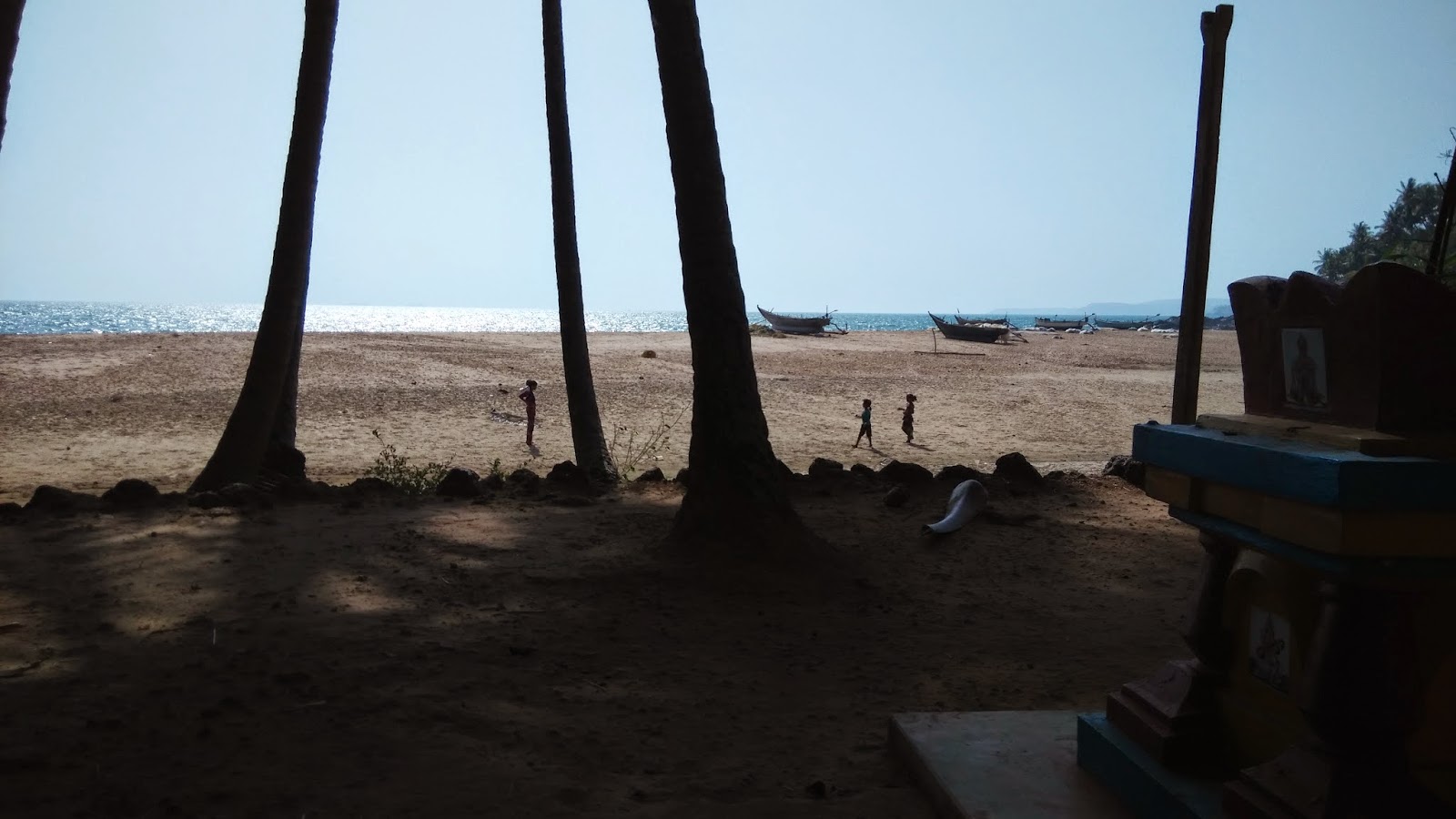
I wake up to a crackle of laughter of local kids nearby. Tejal tried to wake me up once but gave up and is now busy with selfies. We decide to explore the southern flank as well. There's some ongoing construction on this hill that we saw from the other hill. We ask the kids to guide us and they agree. Should be fun this ...
Local kids at Kondura: a.k.a. my alarm and guide
1620 hrs:
Halfway up through the hill the kids stop. Here iss the gate to the under construction place and a fork to go to the other side of the hill. The kids would not go further. We see a solitary worker at the site and ask for permission to enter and see the property. We are turned down - entry is forbidden.
We continue on the track, round the hill and come to face the long Wayangani beach. This beach also has a small freshwater brook running to the sea and the Sagareshwar lighthouse at the hill on the far end. However, like Kondura, there is too much sand deposited which obstructed the brook and raised the slope of the beach. We turn back.
The expanse of Wayangani
1640 hrs:
We again request for admission to the under construction property. We are again denied. The owner is expected soon, so we cannot be let in. We learn a few things though: the property is 8 acres in area, the construction in question is supposed to be a farm-house for family and friends and at current rates the plot was atleast worth Rs 3.5 crore. Its just marginally beyond my budget at the moment, so we say we are not interested and make our way back to the bike.
Also, we learn that sand deposited on the beach was a natural phenomenon. It would be least at the end of monsoon, i.e. September, the time I'd come previously.
The boat perch
Villa overlooking the cliff
1645 hrs:
I make a detour to the Lingeshwar Temple and make a small donation before joining Tejal at the bike. She's found some ratambas (raw kokam fruit) and tried it. The juices have glued to her teeth she says. Our water supply is finished. We push the bike on the slope and at the first house ask for water. This house is quite beautiful and has mango orchard. We see some nice fruit within grasping distance, but control our greed.
We realize that we are running low on fuel. We ask around and learn that the closest fuel pump is at Vengurla.
Mangoes ... just removed
1700 hrs:
We leave Kondura and continue further north. We plan to check the sunset from Mobar beach and then return to Vengurla. We may have just enough fuel to pull it off.
© Kapil Pilankar
Subscribe to:
Posts (Atom)